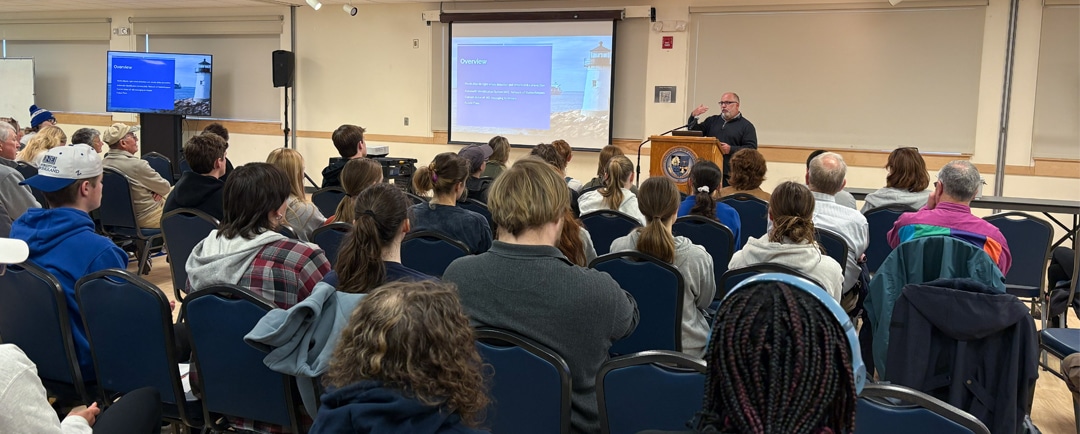
Moses Calouro, CEO of MotionInfo, delivered a lecture on how StationKeeper is helping protect the endangered North Atlantic right whale at the University of New England on April 28, 2026.
(Photo by Ann-Marie Trapani)
Marine biologists and conservationists have been working tirelessly over the last four-plus decades to protect the critically endangered North Atlantic right whale from mortality threats such as vessel strikes and entanglement in fishing gear. These efforts range from policy advocacy and habitat management to raising public awareness and implementing advanced technologies on behalf of a species whose survival hangs in the balance.
Though each of these focus areas are vitally important to the recovery of the North Atlantic right whale, it is cutting-edge technology that is proving to be an absolute game-changer for the present and future of this marine mammal.
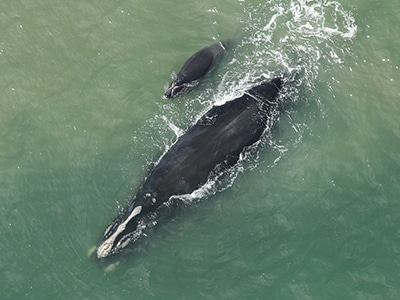
North Atlantic right whale #4617 and her first known calf.
(Photo courtesy of Florida Fish and Wildlife Conservation Commission, taken under NOAA permit #26919)
The efficiency associated with advancements in satellite tracking, passive acoustic monitoring, non-invasive drone-tagging and shore-based Automatic Identification System (AIS) transceiver stations, are every bit as amazing as they are inspiring.
On April 28, 2026, University of New England (Biddeford Campus) students and faculty experienced in the Biology of Marine Mammals, gathered to learn about one of these newest technologies – MotionInfo’s StationKeeper. The AIS-based system is designed to warn mariners when North Atlantic right whales have been observed foraging and traveling through nearby waters.
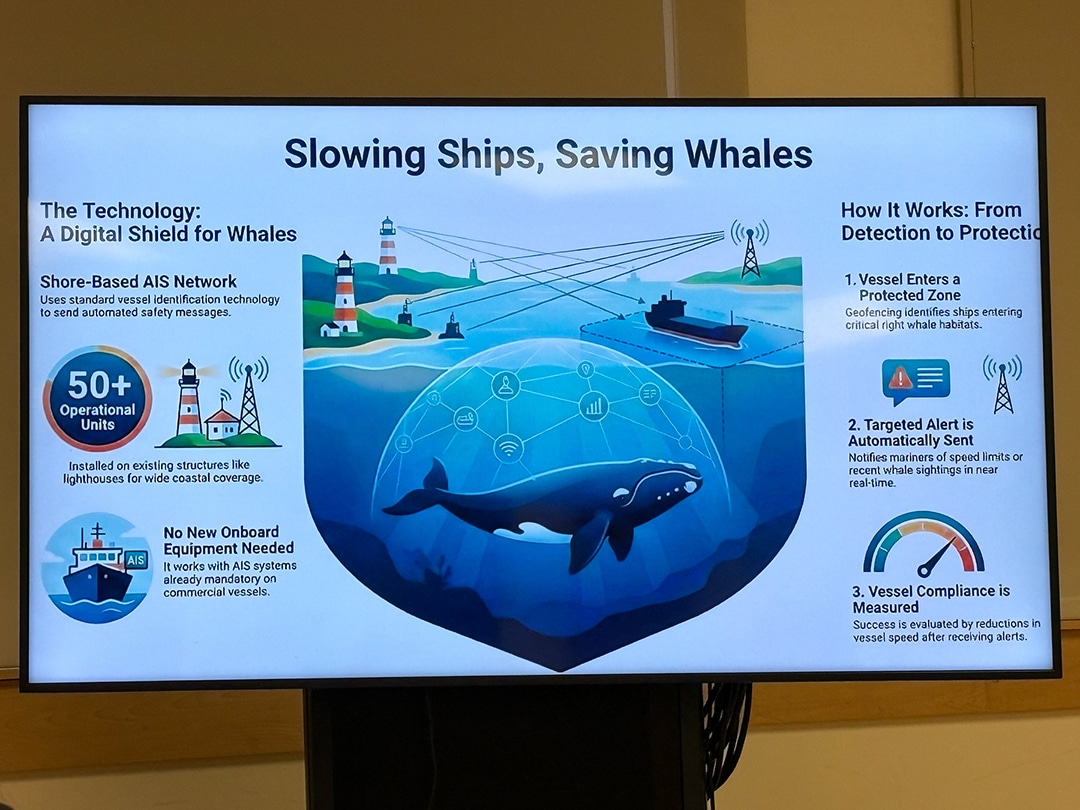
This real-time messaging system transmits an alert directly to a vessel’s (over 65-feet in length) onboard electronic navigational equipment. The alert messages urge vessel operators to reduce their speed to 10-knots or less in an effort to help prevent collisions with North Atlantic right whales.
Ahead of the lecture, the University of New England’s (UNE) website posed the following question to prospective attendees: “What if a single piece of information, delivered at the right moment, could prevent the loss of one of the world’s most endangered marine mammals?”
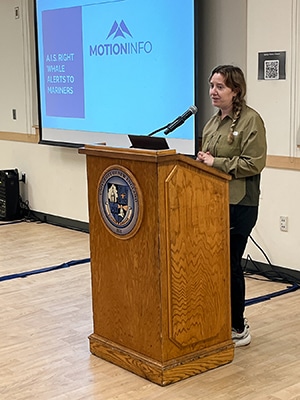
Dr. Michelle Caputo, UNE Assistant Professor, School of Marine and Environmental Programs.
(Photo by Ann-Marie Trapani)
Moses Calouro, CEO of MotionInfo, answered this thought-provoking question and more during his presentation on StationKeeper, which was coordinated by UNE’s Dr. Michelle Caputo, a cetacean ecologist and conservation biologist with 15-years’ experience in marine ecology.
The timing of Calouro’s presentation coincided perfectly with where Dr. Caputo’s students were in their biology of marine mammal studies. “This week we were discussing conservation and management of marine mammals,” said Dr. Caputo. “The lecture specifically touched on how we need innovative solutions to solve complex conservation problems.”
During his presentation, Moses Calouro explained the genesis of StationKeeper, why the technology is urgently needed, the involvement of the National Oceanic Atmospheric Administration (NOAA) and the United States Coast Guard with its operation, how the system works, what can be learned from the data it aggregates and how we can use this vital information to safeguard the North Atlantic right whale.
As the UNE website noted in regards to MotionInfo’s development of StationKeeper, it “highlights how data, real-world constraints, and collaboration across industry, research, and policy shaped the system, and what it takes to turn an idea into something people actually use. At its core, this is a story about how better awareness can drive real change, and how the next generation can be part of building solutions that protect both people and the environment.”
To date, MotionInfo has established sixty-four (64) StationKeeper sites from Maine to Florida. Over half of these units have been installed at historic lighthouses.
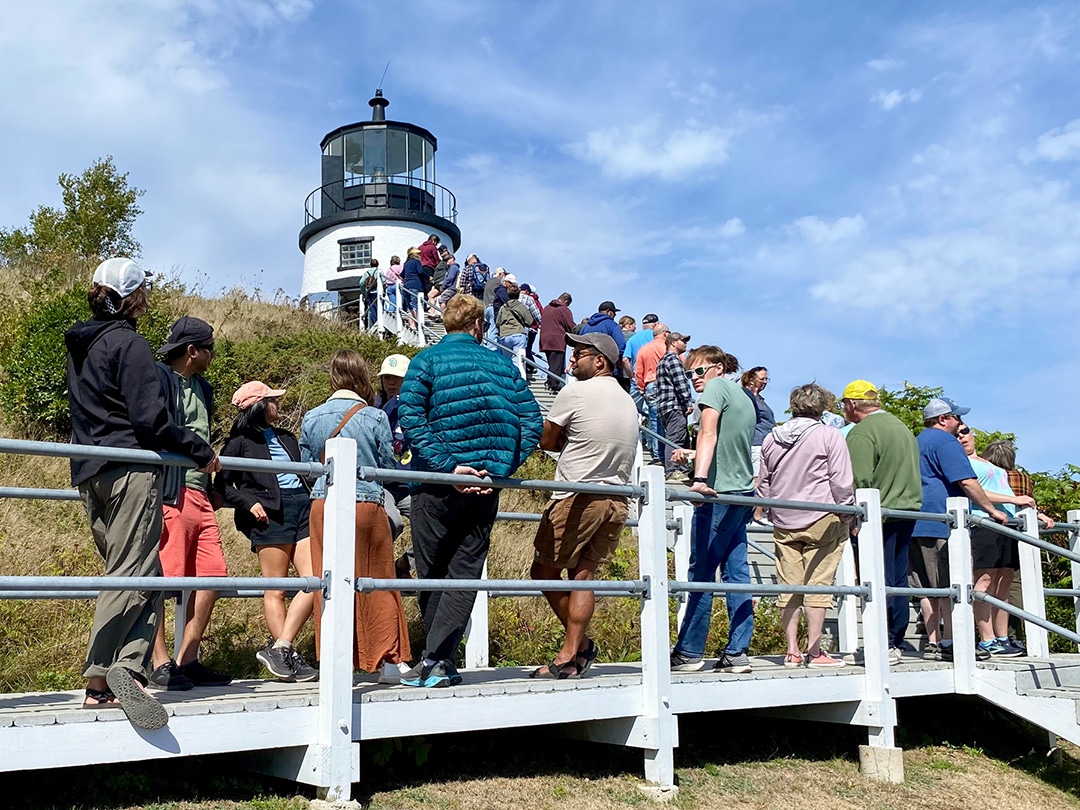
Lighthouses such as Owls Head that serve as host sites for StationKeeper are able to educate visitors on the importance of protecting the North Atlantic right whale.
(Photo by Ann-Marie Trapani)
In light of the role lighthouses are playing as host sites for StationKeeper, ALF Executive Director Bob Trapani, Jr. had an opportunity to speak to UNE students, faculty and guests at the outset of the lecture about their key role. He explained how historic sentinels outfitted with StationKeeper are keeping with a longstanding tradition of embracing conservation, scientific advancements and collaborations with other marine-related entities – and how they are uniquely able to help educate people on the importance of marine mammal conservation through public access programs.
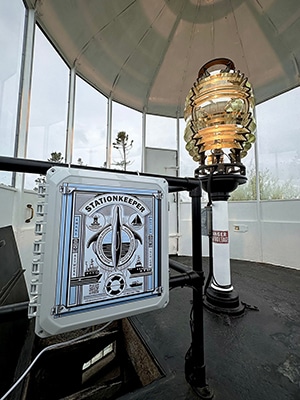
A view of the StationKeeper unit at Owls Head Light – and the beacon’s 1856 Fresnel lens, which still serves mariners.
(Photo by Dominic Trapani)
Trapani went on to note how lightkeepers, beginning in 1900, were appointed by the federal government on behalf of the National Audubon Society, as some of our nation’s first wardens at offshore light stations where threatened seabirds nested. He also explained how – starting in 1921, the U.S. Lighthouse Service adopted state-of-the-art fixed-position radio transmitters (radio beacons) at light stations, and how the National Weather Service worked with the Coast Guard at staffed light stations on gathering vital data for hurricane preparedness during the 1960s and 1970s. And finally, how NOAA partnered with the USCG to establish automated weather stations at lighthouses in the 1980s – an arrangement that continues to this day.
Drs. Michelle Caputo and Cameron Wake, Director, Center for North Atlantic Studies (UNE North) each enjoyed the lighthouse context as it related to StationKeeper’s deployment in the field. Dr. Caputo said, “I think the story of giving lighthouses back their original purpose – in a new way, is really cool and struck a chord with many of us.”
Following the lecture, Dr. Michelle Caputo, Moses Calouro and Bob Trapani, Jr., participated in a very engaging Q & A with UNE students, faculty and guests. Questions ranged from system operations and its diverse capabilities to obtaining collected data for measuring impact and the unit’s presence inside lighthouses from a heritage perspective.
Dr. Caputo stated, “I’m hoping the students were inspired by a successful collaborative conservation story and the importance of being creative, using tools we already have, and adapting to changing environments.”
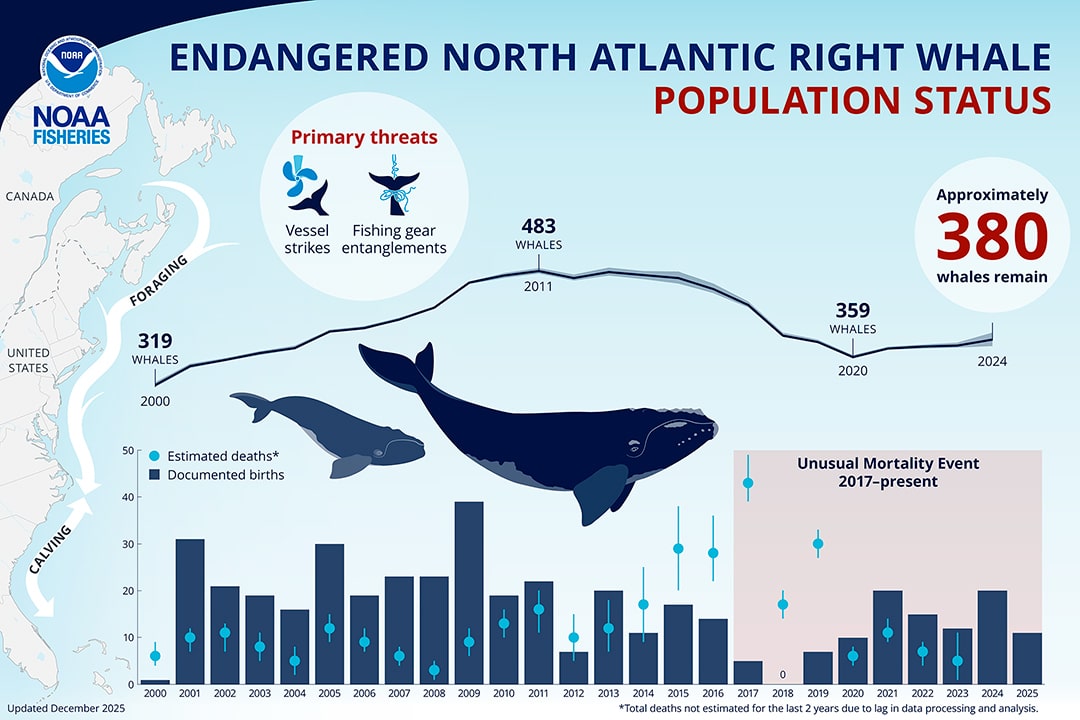
Marine biologists and conservationists have been working tirelessly over the last four-plus decades to protect the critically endangered North Atlantic right whale from mortality threats such as vessel strikes and entanglement in fishing gear.
(NOAA graphic)
Students participating in the University of New England’s Biology of Marine Mammals graduate-level course develop critical thinking skills related to conservation, and understanding complex marine ecosystems. By studying and engaging in the plight of the North Atlantic right whale, the experience serves as a case study for biology, oceanography, and environmental policy. The undergraduates also have an opportunity to study real-time data and research innovative solutions – all the while fostering a keen sense of stewardship.
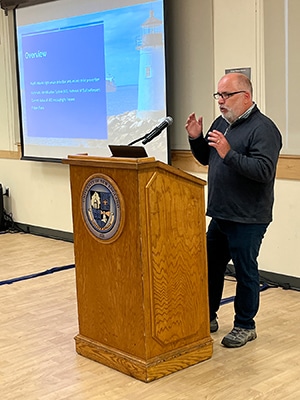
MotionInfo CEO Moses Calouro explains how the AIS-based StationKeeper works to UNE students, faculty and guests.
(Photo by Ann-Marie Trapani)
MotionInfo CEO Moses Calouro expressed his admiration for the knowledge and passion of UNE’s students and faculty, saying, “It was a pleasure meeting so many of the students and answering questions about the system. Having spent so much time working along the coast on this project, it was truly a breath of fresh air to be in a room with those who have long carried the torch for education, research, and the protection of both maritime heritage and marine life ecosystems sitting alongside the students who are actively preparing to carry that light forward.”
In the wake of Moses Calouro’s lecture, James D. Herbert, President of the University of New England, stated, “I enjoyed spending time with UNE’s marine science community today for a compelling discussion on the StationKeeper Whale Alert System and the role innovation in protecting one of the world’s most endangered marine mammals.”
President Herbert went on to say, “Moses Calouro, CEO of Maritime Information Systems (MotionInfo) shared the story behind StationKeeper – a real-time alert system that helps vessels navigate safely in sensitive marine habitats, including those of the North Atlantic right whale. Once on the brink of extinction, this species is now showing encouraging signs of recovery.”
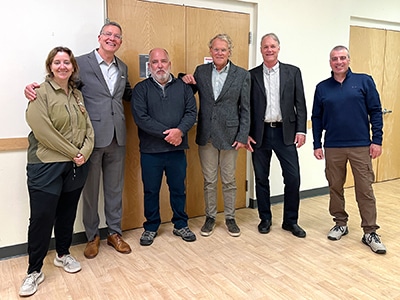
(L to R) Dr. Michelle Caputo, UNE Assistant Professor, James D. Herbert, UNE President, Moses Calouro, MotionInfo CEO, Ford Reiche, UNE Trustee, Dr. Cameron Wake, UNE Director, Center for North Atlantic Studies, and Bob Trapani, Jr., ALF Executive Director.
(Photo courtesy of ALF)
“Thank you to UNE trustee Ford Reiche, who helped bring this initiative to the University, and faculty leaders, Drs. Cameron Wake and Michelle Caputo, along with Dr. Caputo’s students, for being instrumental in deploying StationKeeper technology at Halfway Rock, Wood Island, and Goat Island lighthouses in 2025,” concluded President Herbert. “It’s inspiring to see UNE faculty, students, and partners contributing to work that is driving real impact at the intersection of science, technology, and conservation.”
According to Dr. Michelle Caputo, her Biology of Marine Mammals class, which touches on all aspects of marine mammal evolution and biology, concludes with a conversation unit that asks, “where do you fit in” message. Based on what was observed throughout Moses Calouro’s lecture, UNE’s students will not only find their meaningful place in the world of marine mammal conservation, they will excel and shine bright!
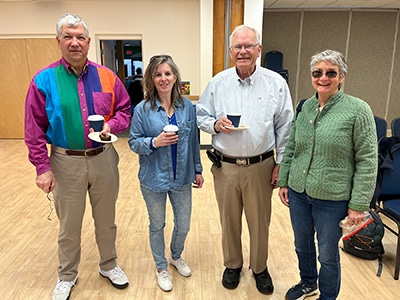
(L to R) Carl Gatto, FOWIL, Ann-Marie Trapani, ALF Associate Director, George Bruns, ALF Board Member and FOWIL Chairperson and Amy Robinson, FOWIL.
(Photo by Bob Trapani, Jr.)
As for the American Lighthouse Foundation, the nonprofit organization was well-represented at the University of New England’s lecture. In addition to ALF Executive Director Bob Trapani, Jr., others in attendance were: Ann-Marie Trapani, ALF Associate Director, Gary Childs, ALF Board Member and Cape Cod Chapter Chairperson, George Bruns, ALF Board Member and Friends of Wood Island Lighthouse (FOWIL) Chairperson, and Carl Gatto, Amy Robinson, David Adams and Walter Fowski of FOWIL. Also, Ford Reiche, an ALF Storm & Mitigation Response Team member, was in attendance.
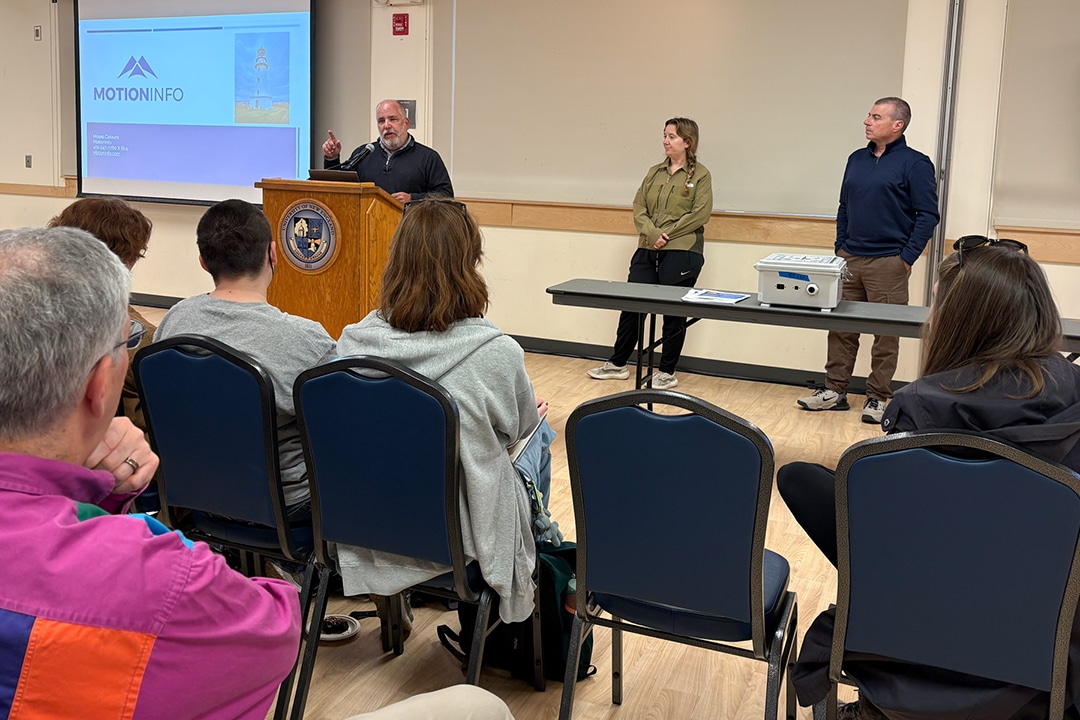
Following the lecture on StationKeeper, (L to R) Moses Calouro, Dr. Michelle Caputo, and Bob Trapani, Jr., participated in a very engaging Q & A with UNE students, faculty and guests.
(Photo by Ann-Marie Trapani)
During his lecture, Moses Calouro explained the genesis of StationKeeper, why the technology is urgently needed, the involvement of the National Oceanic Atmospheric Administration (NOAA) and the United States Coast Guard with its operation, how the system works, what can be learned from the data it aggregates and how we can use this vital information to safeguard the North Atlantic right whale.
(Photo by Ann-Marie Trapani)
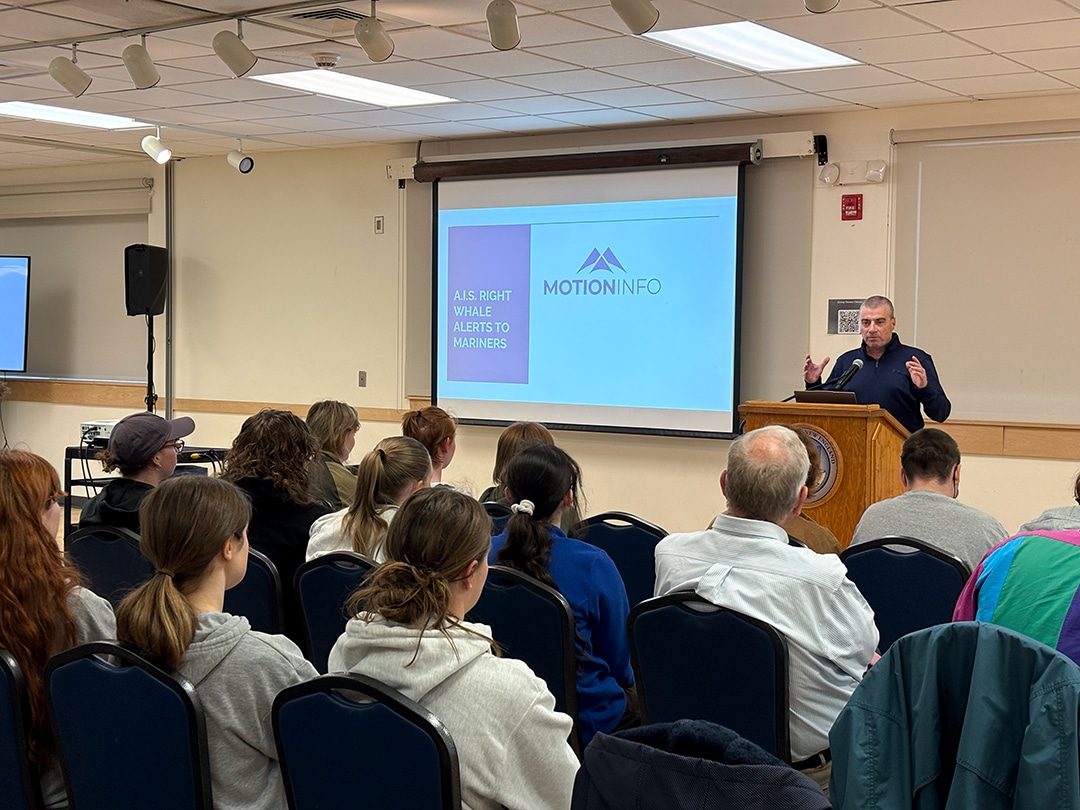
American Lighthouse Foundation Executive Director Bob Trapani, Jr., explained the role lighthouses are playing as host sites for StationKeeper. He noted how historic sentinels are keeping with a longstanding tradition of embracing conservation, scientific advancements and collaborations with other marine-related entities. (Photo by Ann-Marie Trapani)
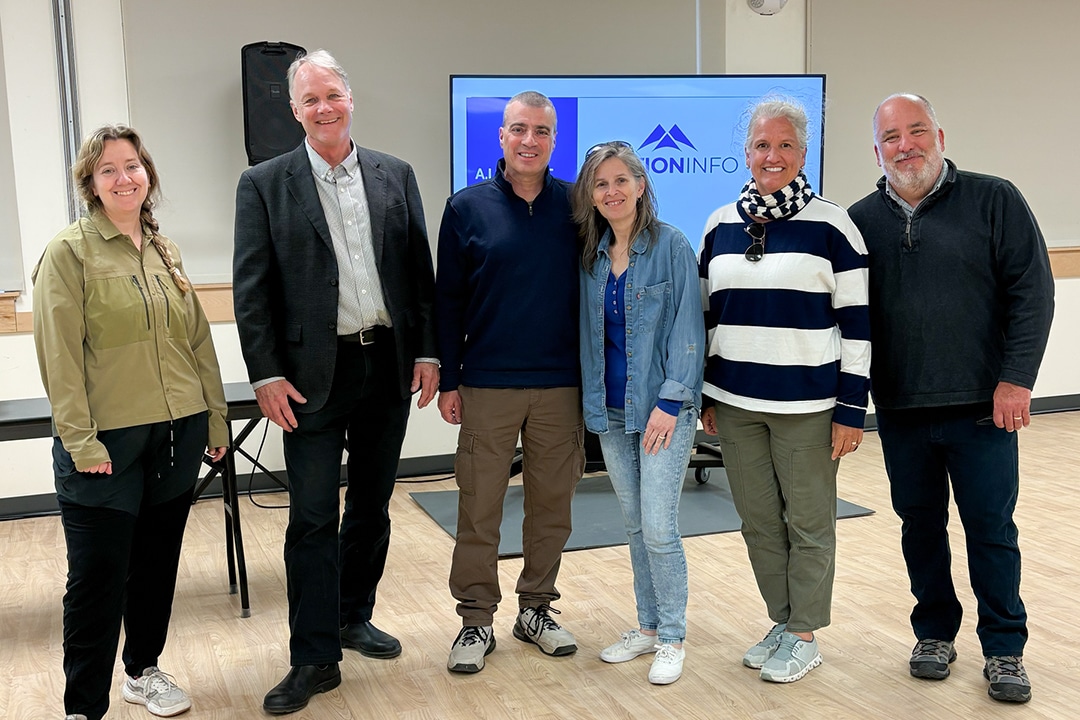
A fun pre-lecture group photo! (L to R) Dr. Michelle Caputo and Dr. Cameron Wake of UNE, Bob Trapani, Jr. and Ann-Marie Trapani of ALF and Portia Calouro and Moses Calouro of MotionInfo. (Photo courtesy of ALF)