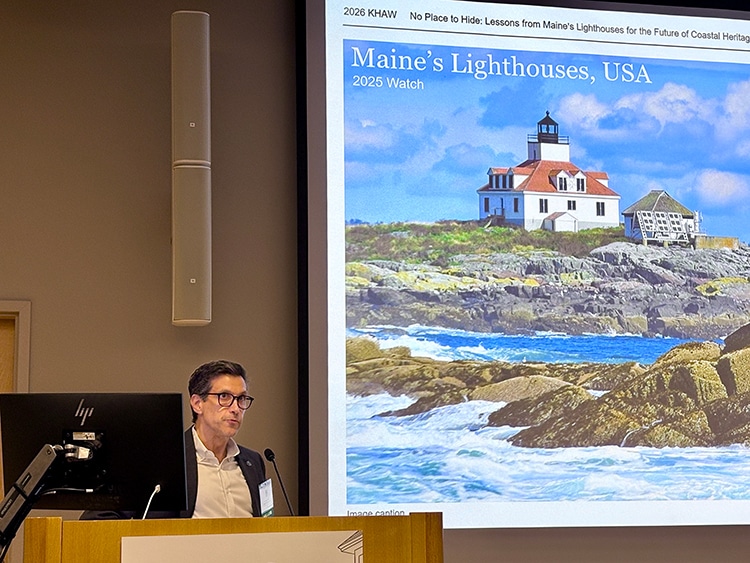
Jon Buono, AIA, APT RP, World Monuments Fund’s Senior Regional Director for the USA and Canada, talked about the WMF’s Watch List, Coastal Connections program and commitment to helping heritage sites become more resilient around the globe at the Newport Restoration Foundation’s Keeping History Above Water Symposium, October 21-23, 2026.
(Photo by Ann-Marie Trapani)
Lighthouses the world over stand on the front lines of our changing climate. From more intense storms and rising sea levels to flooding and erosion, these venerable guardians – some more than two centuries old, are facing threats like never before.
The urgency of this challenge becomes more and more evident when examining observed trends and the growing body of data, which confirm both what we can see with our own eyes and what may not be so readily discernible.
For decades, the preservation community has enjoyed much in the way of success by applying traditional approaches and techniques to protecting our built heritage, including historic light stations. However, strategies that once worked well are proving less effective as communities confront the realities of increasingly urgent climate vulnerabilities.
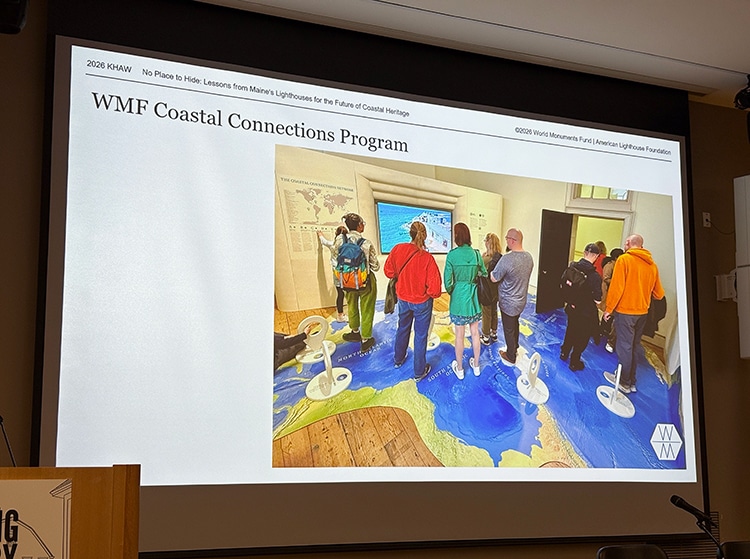
The World Monuments Fund’s Coastal Connections program is a global joint initiative that addresses climate adaptation for cultural and heritage sites.
(Photo by Ann-Marie Trapani)
These challenges, along with potential solutions, were among the many topics shared with attendees during the Newport Restoration Foundation’s tenth annual Keeping History Above Water symposium – a three-day event held at the Salve Regina University and Rough Point Museum in Newport, Rhode Island.
Held October 21–23, 2026, the symposium, titled “Looking Back, Moving Forward,” brought together historic preservationists, architects, climate scientists, policymakers, community leaders, and local residents to find practical ways to protect historic buildings, cultural landmarks, and coastal communities from the effects of our changing climate.
Over the course of the three-day event, attendees had the opportunity to participate in fourteen educational panels and eight site visits. According to the Newport Restoration Foundation, the symposium focused on “sea level rise, recurrent flooding, and climate adaptations for historic coastal structures (such as regional lighthouses and waterfront landmarks), featuring groups like the World Monuments Fund and the National Trust for Historic Preservation.”
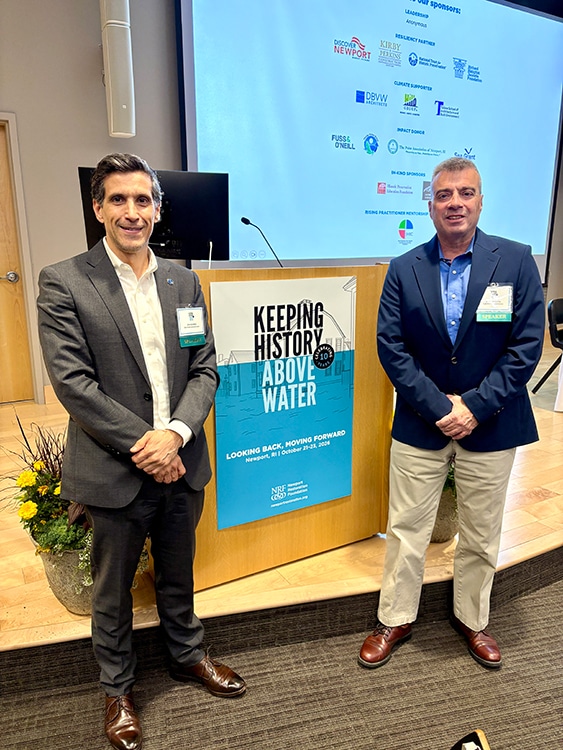
Keeping History Above Water (KHAW) is a global and national initiative founded in 2016 by the Newport Restoration Foundation to address sea-level rise and climate threats to historic coastal architecture.
(L to R) Jon Buono,AIA, APT RP, World Monuments Fund’s Senior Regional Director for the USA and Canada, and Bob Trapani, Jr., American Lighthouse Foundation Executive Director, co-presented a program titled “No Place to Hide: Lessons from Maine’s Lighthouses for the Future of Coastal Heritage” at the KHAW symposium.
(Photo by Ann-Marie Trapani)
The Newport Restoration Foundation went on to note, “Continuing Doris Duke’s vision for preserving and restoring cultural heritage, Keeping History Above Water® was founded in 2016 to foster a global conversation focused on the increasing and varied risks of sea-level rise to historic coastal communities.
“As a leader in the preservation of early American architecture, the Newport Restoration Foundation is responding to the threat of climate change through Keeping History Above Water (KHAW) – which brings interdisciplinary conferences and workshops focused on protecting historic assets, cultural resources, and neighborhoods to vulnerable regions across the country and around the world.”
On the final day of the symposium, Jon Buono, AIA, APT RP, World Monuments Fund’s Senior Regional Director for the USA and Canada, and Bob Trapani, Jr. Executive Director for the American Lighthouse Foundation, co-presented a program titled “No Place to Hide: Lessons from Maine’s Lighthouses for the Future of Coastal Heritage.”
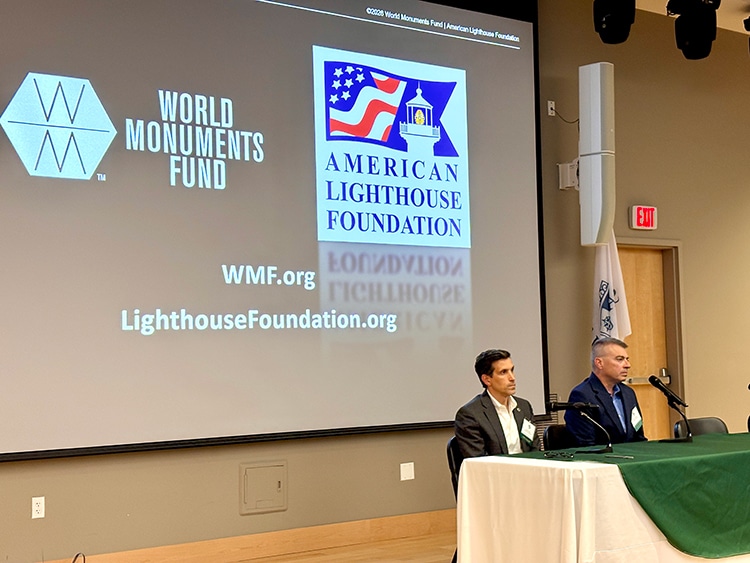
Following their presentation at the Keeping History Above Water symposium, the WMF’s Jon Buono (left) and ALF’s Bob Trapani, Jr. participated in a Q & A session with the audience.
(Photo by Ann-Marie Trapani)
Buono opened the presentation by highlighting several World Monuments Fund initiatives, including its biennial Watch and Coastal Connections program – a global joint initiative launched in 2023 by the WMF and English Heritage to protect coastal heritage sites from climate change, sea-level rise, and erosion.
“We began the morning with a dire forecast of our collective futures,” said Jon Buono. “We could feel overwhelmed, we could question, how does what we do even matter? Are we just arranging the deck chairs on the Titanic, as the saying goes? But I want to reassure this audience the importance of our daily work.”
Buono went on to emphasize the need for preservation professionals to adapt their approaches to meet the realities of a changing environment, “We need to get smart, and we may need to get beyond the arrested nature of our sites. In order to manage the real nature that affects them. We need to re-focus our service to our communities, our nations, and the world, in working on behalf of the cultural heritage that cannot defend itself – and that gives humanity its meaning, its inspiration, and its joy. We are central to those legacies. We as a profession need to adapt, just like our sites.”
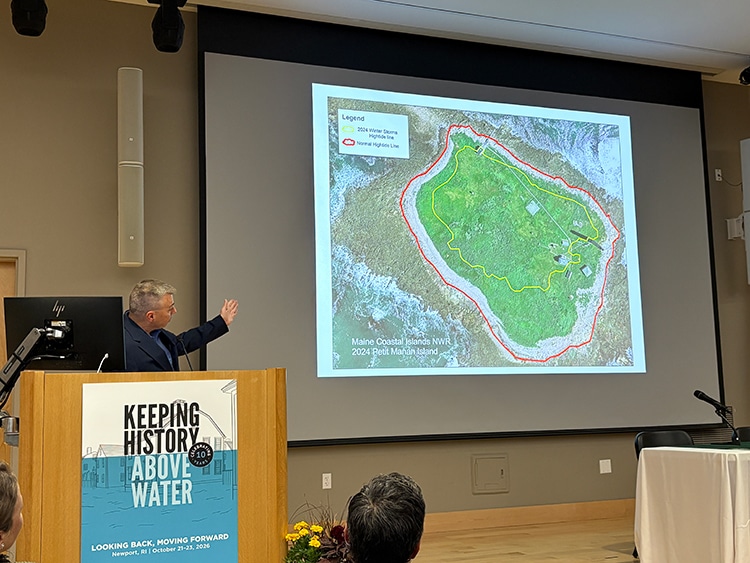
American Lighthouse Foundation Executive Director Bob Trapani, Jr., shared with the KHAW audience a number of climate vulnerabilities facing Maine’s light stations, including storm surge / flooding at sites like Petit Manan Island Light Station. The red line on the screen image represents normal high tide. The yellow line shows how high the storm surge reached on Petit Manan Island during the back-to-back January 2024 storms. Petit Manan is part of the Maine Coastal Islands National Wildlife Refuge and home to nesting seabirds (Atlantic Puffins, Terns, Razorbills, etc.). The island is owned and cared for by the U.S. Fish & Wildlife Service.
(Photo by Ann-Marie Trapani)
He concluded with a call for continued advocacy and action: “So, we should leave here with the mission to empower our elected officials who embrace both science and heritage, to demand corporate responsibility for the environment, but not to underestimate the value of what we do.”
Following Buono’s remarks, Bob Trapani, Jr. presented an overview of the January 2024 Maine light station storm experience, sharing lessons learned and outlining best practices being pursued to improve resilience. His presentation addressed mitigation, resiliency, and funding challenges, emphasizing the value of a collective network approach rather than treating each historic light station as an isolated preservation challenge.
Trapani also discussed how the American Lighthouse Foundation, a national leader in lighthouse preservation, established a Storm & Mitigation Response Team in the aftermath of the two devastating 2024 storms. The team was formed to help light station stewards better understand and navigate the complexities of incorporating resiliency into the fabric of their historic properties. He explained that the research and data being collected by this team will help inform and strengthen resilience strategies for light stations beyond Maine as well.
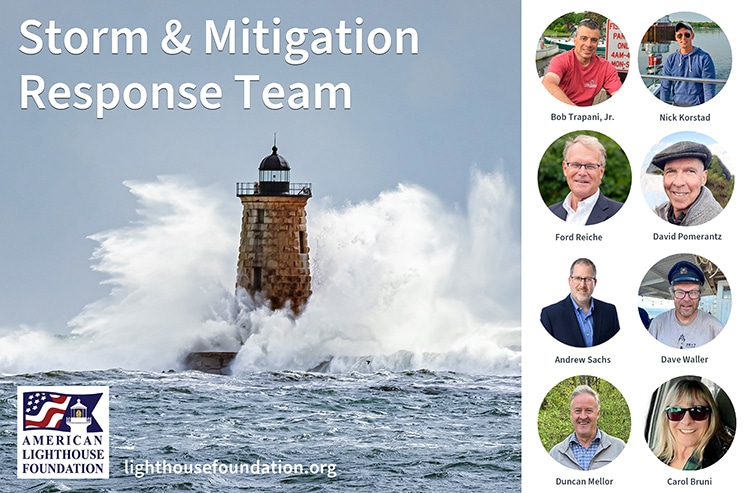
During the Newport Restoration Foundation’s Keeping History Above Water symposium, Bob Trapani, Jr., ALF Executive Director, talked about how the organization created a Storm & Mitigation Response Team in the wake of the January 2024 storms.
(Graphic by Ann-Marie Trapani)
Trapani also highlighted ALF’s current collaboration with the World Monuments Fund, Maine Preservation, the University of Pennsylvania’s Weitzman School of Design, and Columbia University’s Graduate School of Architecture, Planning and Preservation. Through overlapping fall-semester studios, these academic institutions are examining Maine’s light stations from a variety of perspectives, including historic preservation, climate adaptation, collaborative networks, and systems-based approaches.
From the perspective of lighthouse preservation, the Keeping History Above Water symposium was especially significant in underscoring the need to protect historic coastal landmarks from the growing threats of sea-level rise, flooding, and climate change. By bringing together preservationists, engineers, planners, and community members, the Newport Restoration Foundation’s KHAW symposium encouraged collaboration and the sharing of strategies to safeguard historic resources, including coastal light stations.
The climate change plight is compelling the preservation community to rethink longstanding approaches. Identifying and implementing more effective mitigation and resiliency solutions is essential if we are to prevent further losses of our historic and cultural resources.
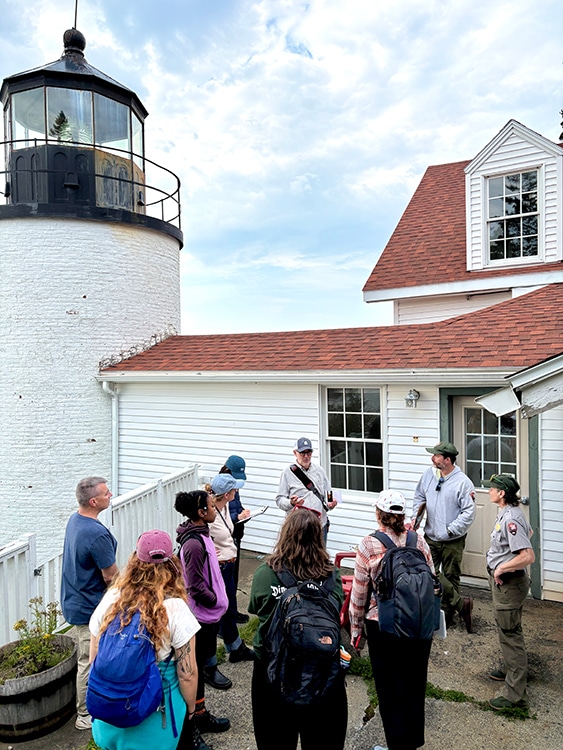
Bob Trapani, Jr., ALF Executive Director, shared with the KHAW audience how the World Monuments Fund, American Lighthouse Foundation, Maine Preservation, University of Pennsylvania and Columbia University are collaborating on overlapping fall-semester studios; examining Maine’s light stations from a variety of perspectives, including historic preservation, climate adaptation, collaborative networks, and systems-based approaches.
Shown here are UPENN Weitzman School of Design graduate students – led by Professor Randall Mason, talking with representatives of the National Park Service and American Lighthouse Foundation at Bass Harbor Head Light.
(Photo by Ann-Marie Trapani)
This need to adapt to changing environmental realities has placed the preservation community at a crossroads—but one that also presents opportunities. It is inspiring preservationists to explore more progressive methodologies to save our built heritage, while also reassessing strategies to ensure these irreplaceable resources are endowed with new purpose. By doing so, we will strengthen community value and encourage great investment in the now.
The Richard Hampton Jenrette Foundation, a proud sponsor of and participant in the Newport Restoration Foundation’s Keeping History Above Water: Looking Back, Moving Forward symposium, shared the following perspective, “The future of historic preservation depends on how we respond to a changing climate.
“From traditional building trades and material conservation to coastal resilience planning, living documentation, and nature-based solutions, the sessions highlighted an essential principle: preservation is not simply about protecting the past. It is about developing the knowledge, skills, and strategies that will allow historic places to endure.”
The Richard Hampton Jenrette Foundation concluded, “Supporting this work reflects the Foundation’s commitment to education, innovation, and stewardship in historic preservation, decorative arts, and historic landscapes. By sharing expertise across disciplines and learning from places already confronting these challenges, we can strengthen the practice of preservation for generations to come.”
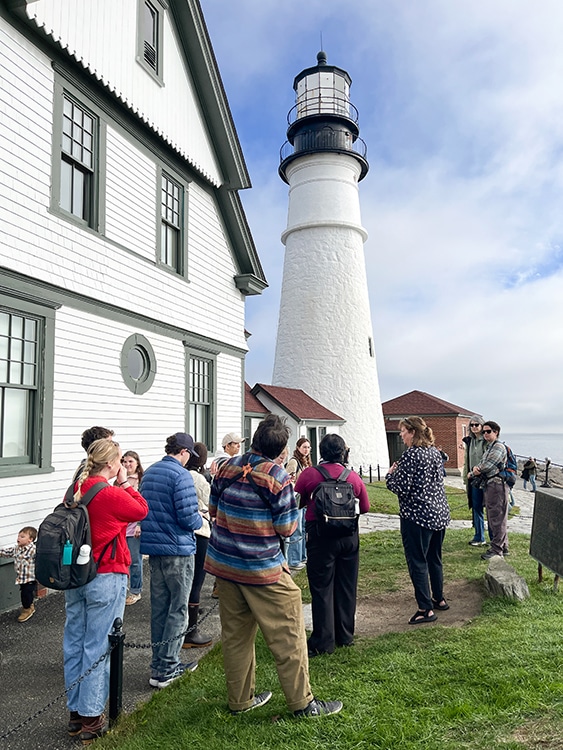
Bob Trapani, Jr., ALF Executive Director, shared with the KHAW audience how the World Monuments Fund, American Lighthouse Foundation, Maine Preservation, University of Pennsylvania and Columbia University are collaborating on overlapping fall-semester studios; examining Maine’s light stations from a variety of perspectives, including historic preservation, climate adaptation, collaborative networks, and systems-based approaches.
Shown here are students from Columbia University’s Graduate School of Architecture, Planning and Preservation – led by Professor Erica C. Avrami, talking with representatives of the Town of Cape Elizabeth’s (Maine) Fort Williams Park and American Lighthouse Foundation at Portland Head Light.
(Photo by Bob Trapani, Jr.)
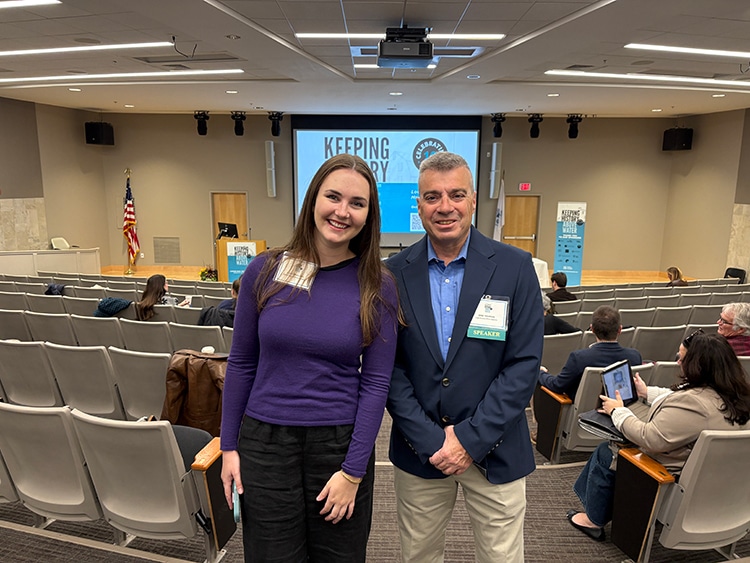
(L to R) Ellis McClure, a Weitzman School of Design, University of Pennsylvania student, and Bob Trapani, Jr., American Lighthouse Foundation Executive Director, at the 2026 Newport Restoration Foundation’s Keeping History Above Water Symposium. Ellis McClure is participating in the Weitzman School of Design’s 2026 fall-semester preservation studio entitled, “BEACONS: Philadelphia houses of creative geniuses / Maine light stations.”
(Photo by Ann-Marie Trapani)
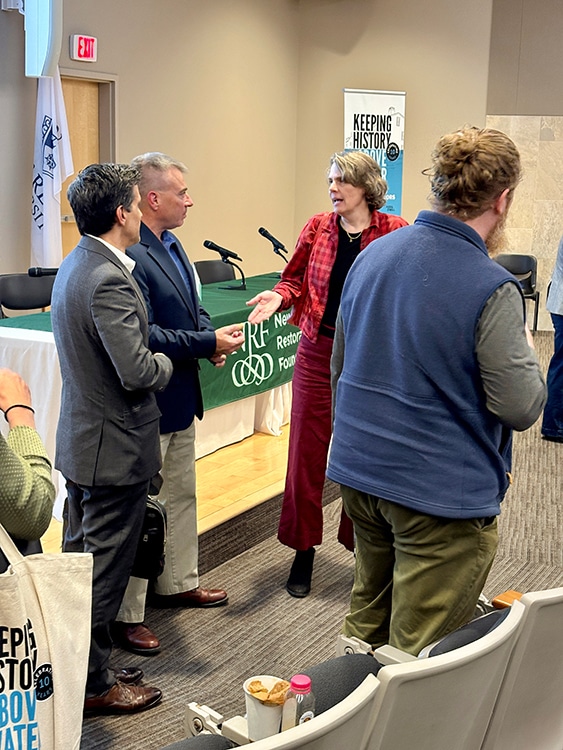
Jon Buono, World Monuments Fund, and Bob Trapani, Jr., American Lighthouse Foundation (on left) talk with a Keeping History Above Water symposium attendee following their presentation on Maine’s light stations.
(Photo by Ann-Marie Trapani)
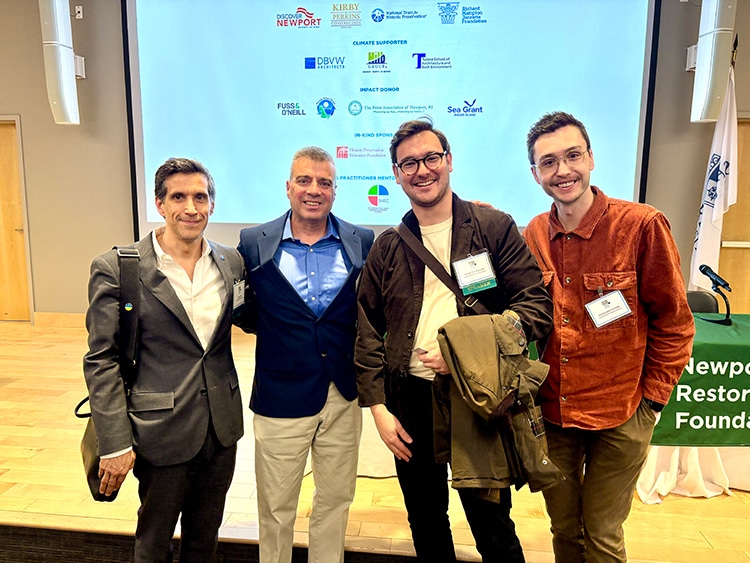
(L to R) Jon Buono, AIA, APT RP, World Monuments Fund’s Senior Regional Director for the USA and Canada, Bob Trapani, Jr., Executive Director, American Lighthouse Foundation, Jacob Torkelson, Senior Research Associate at the Preservation Research Collaborative at Penn, and Brian Whetstone, Assistant Professor, Weitzman School of Design, University of Pennsylvania, at the Newport Restoration Foundation’s Keeping History Above Symposium, October 23, 2026.
(Photo by Ann-Marie Trapani)

Leave a Reply