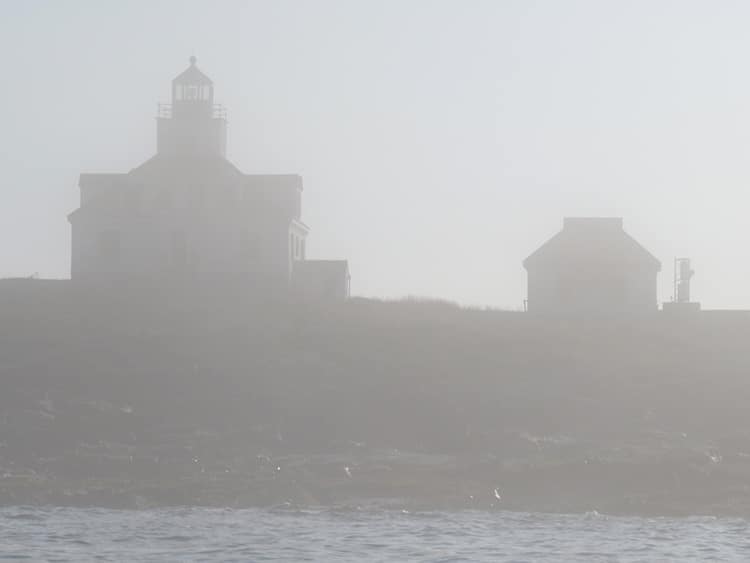
Egg Rock Lighthouse in the fog.
(Photo by Bob Trapani, Jr.)
The following Op-Ed was written by Zack Klyver, November 22, 2026
Part One: Stumpy
In 1992, I was a young 24-year-old Bar Harbor whale watch naturalist and College of the Atlantic student. I had been guiding whale watching tours for a couple of seasons and on this warm summer day we cruised out of Frenchman Bay on the Acadian Whale Watcher. Just after passing Egg Rock Lighthouse, we were enveloped in a wall of fog. Fortunately, it was flat calm and it was not pea soup fog – we could see a few hundred feet. We spent the morning in our offshore whale area slowly moving around, listening for whales breathing at the surface, and looking for whale footprints. Eventually, having no luck we headed back toward shore and our dock.
Suddenly we saw a large disturbance on the ocean’s surface ahead and what looked like round circular eddies left on top of the water by a whale’s tail. We slowed down and sure enough a whale surfaced traveling southwest – going down the coast of Maine. It was not just any whale; it was an endangered North Atlantic right whale! We spent the next 30 minutes gently following along well behind its trail of massive whale footprints. Its immense blow and breath echoed across the water each time it surfaced. When it dove it would raise up its gigantic black tail and the tail coloration and shape were unique. It had a white circle on the left side, and the right tip of its tail was missing due to boat propeller strike earlier in its life.
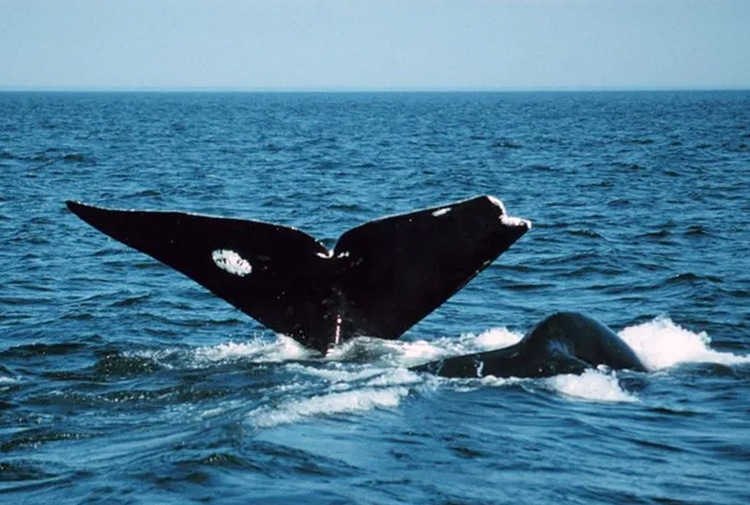
Right Whale “ Stumpy” #1004.
(New England Aquarium Right Whale Research Program photo)
The next day I took my film in to be processed and sent the images to the New England Aquarium research team in Boston directed by Scott Kraus, another COA graduate. The Aquarium maintains a photo catalogue with all the right whales and tracks each whale by name. Today, that catalogue has images going back to 1935 and holds over 2 million images. Additionally, each whale has a report card that tracks its individual health and any new scars from vessel encounters, ship strikes, or entanglements. For example, 87% of right whales have entanglement scars from being caught up in fishing line and some individual whales have been entangled 7 times.
In due course I heard back from the research team that this was a famous female right named Stumpy (Catalog #1004), AKA the “mother of all right whales”. She had first been identified in 1975 and immediately became my favorite right whale. I would ask about her whereabouts when I had the opportunity. Occasionally our paths would overlap in the Southeast as I spent ten years on ships and in planes between North Carolina and Florida looking for right whales in the winter months as part of the warning system to have ships to slow down so they would not hit them. Whale ship strikes along with fishing line entanglements have been and are the two highest causes of right whale mortality.
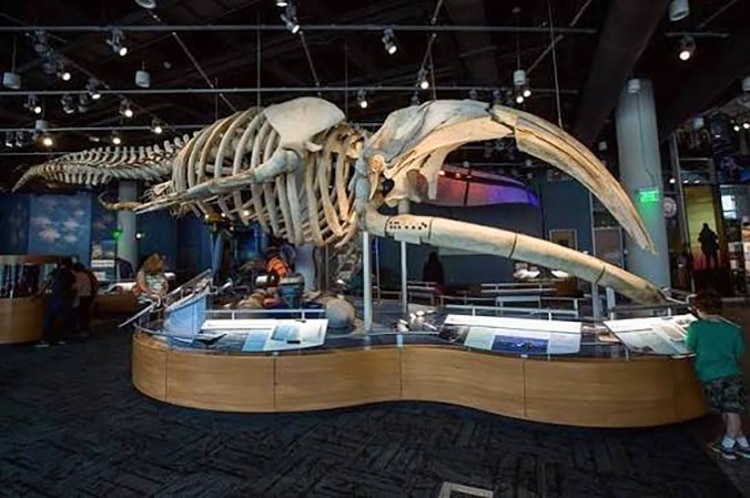
Right Whale “ Stumpy” #1004.
(North Carolina Museum of Natural Sciences photo)
In February 2004 we received heart-breaking news, Stumpy had tragically been killed in a fatal ship strike off the coast of North Carolina/Virginia. When the stranding team conducted a necropsy, they found Stumpy was 52 feet in length and pregnant with a 17-foot-long late-term male fetus. Previously, she had given birth to five known calves, but the fact that she was pregnant when killed hit home doubly hard. Today, her and the fetus are on display at the North Carolina Museum of Natural Sciences in Raleigh and were assembled by College of the Atlantic alumni and whale bone specialists Dan DenDanto and Toby Stephenson. Sadly, from 1980 to 2024, scientists documented 122 vessel strike injuries involving North Atlantic right whales in U.S. and Canadian waters, including 42 confirmed fatalities (27 in the U.S. and 15 in Canada). Likely the real number is much higher.
Whale Oil Consumption by Lighthouses
Pre-whaling estimates of North Atlantic Right Whale abundance have been given as 9,000 to 21,000 with a population estimate today numbering around 382. The Right Whale was named that because it was the right whale for whalers to hunt. It’s thick layer of blubber meant that it floated once killed and yielded great amounts of oil to light lamps and as a lubricant in human machines. Originally, the Basque whalers began hunting them from the coast 1000 years ago and made-up flags for each port with whales on them. The population of right whales that once inhabited the waters between Spitsbergen and the Bay of Biscay, the eastern Atlantic stock, is now completely gone.
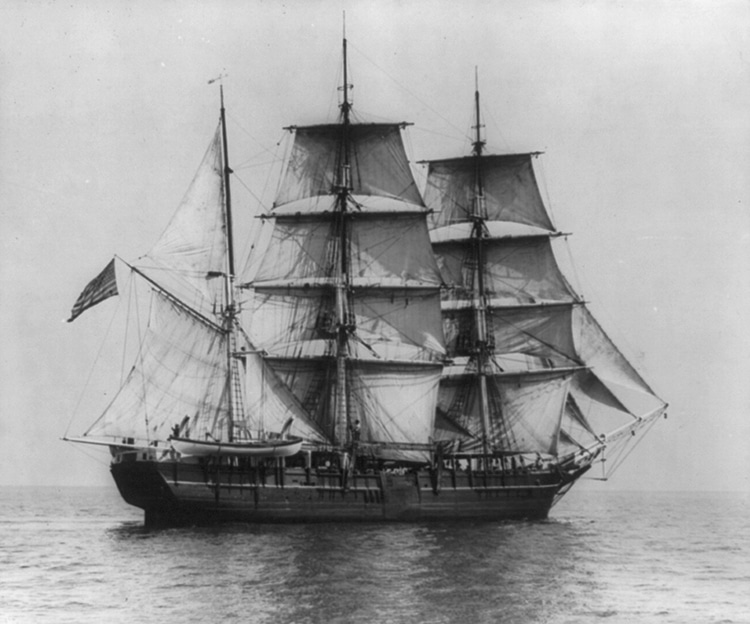
American Whaling Ship Charles Morgan.
(Library of Congress photo)
In the Western North Atlantic, early European settlers described extraordinary numbers of whales along the New England coast. When the Mayflower arrived in Cape Cod Bay in 1620, its passengers reported seeing whales daily, while Richard Mather described multitudes of great whales in Massachusetts Bay in 1635. New England ports like New Bedford, Nantucket, and New London, Connecticut became the center of American whaling operations. By the 1850’s there were over 700 whaling ships and nearly 70,000 people involved in the whaling industry. The right whale was a main target and today we are left with just a remanent western Atlantic population.
An important use of whale oil was to light the lighthouses to provide commercial mariners’ safe passage. In America’s early history we were a maritime nation and people, goods, and supplies were brought up and down the coast on ships. Ships needed lighthouses to guide their way. A historical account of Boston Light notes that oil from right whales was a common lighting fuel when the lighthouse was established in 1716.
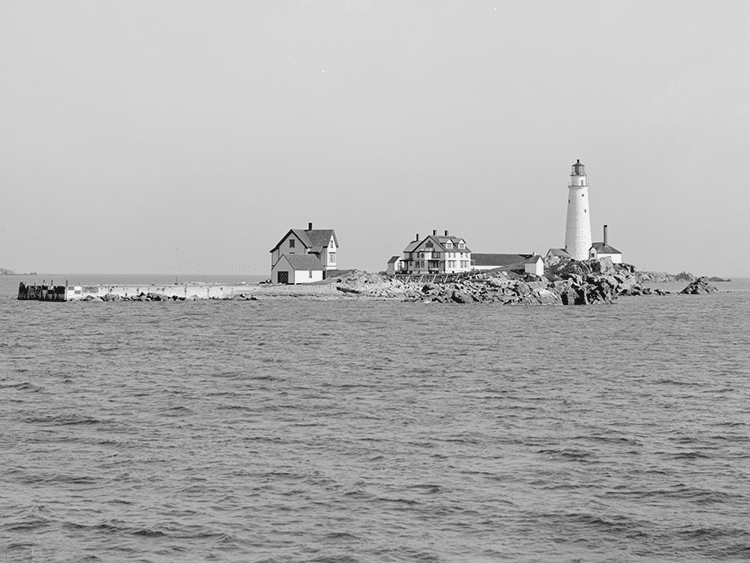
Boston Light Station, Little Brewster Island in outer Boston Harbor, Massachusetts.
(Library of Congress photo)
From the early 1700’s until the mid-1800’s whale oil provided the fuel to light the lighthouse lamps. During the American commercial whaling era, a North Atlantic right whale typically yielded approximately 60–75 barrels of whale oil, although particularly large whales could produce 100–130 barrels and 1,500 pounds of baleen. Each barrel of whale oil contained 31.5 gallons. So, a large right whale might produce over 3,000 gallons.
Historical records suggest that the amount of oil used varied by lighthouse and the number of lamps but that it was common for a lighthouse to annually use hundreds of gallons. The 1852 Lighthouse Board report states that the standard allowance was 35 gallons per lamp. The Boston Light before 1811 with its old lighting system used approximately 1,612 gallons annually but with new improvements after 1811 reported using 468 gallons annually. The Sandy Hook Lighthouse in New Jersey at the entrance to New York City used 661 gallons of whale oil in 1852.
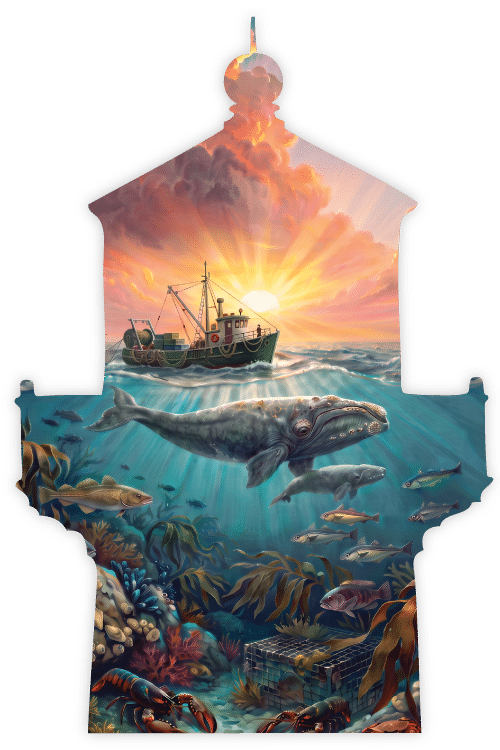
Thanks to MotionInfo’s AIS-based StationKeeper technology, historic lighthouses hosting this equipment are now able to help protect the endangered North Atlantic right whale.
(Graphic by Ann-Marie Trapani)
“Save The Whales” with Lighthouses!
On November 8th the American Lighthouse Foundation (ALF) held its annual Gala, Charting New Horizons Together, at the Nonantum Resort, Kennebunkport, Maine. The afternoon included incredible food, an auction, speeches, and a chance to honor some of ALF’s finest volunteers with Len Hadley Volunteer Award ceremony.
A central theme of the afternoon centered on the use of lighthouses in wildlife conservation. Recently, immense collaborative strides that have been made to outfit lighthouses along the east coast of the United States with radio towers that can send messages to ships when they enter a right whale seasonal or a dynamic slow down zone that has been triggered by right whale presence.
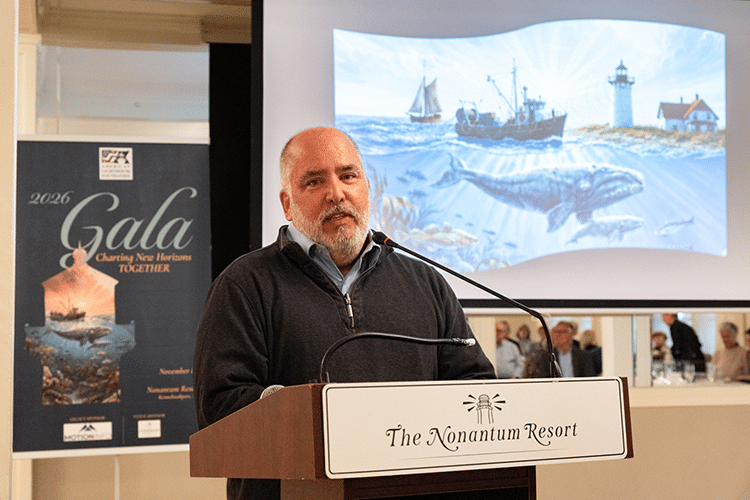
Moses Calouro, CEO of MotionInfo, speaks with attendees about StationKeeper during the American Lighthouse Foundation’s Gala.
(Photo by Dominic Trapani)
Moses Calouro (CEO), alongside his wife Portia Calouro, manage this project called StationKeeper through their company MotionInfo. Moses spoke at the gala and described how the technology works using Automatic Identification System (AIS) VHF radio transceivers to transmit electronic signals and text-like safety alerts to ships and vessels over 65 feet in length. Approximately 40 lighthouses are part of the program, of which 12 are ALF lights or affiliates.
Lighthouses offer the perfect platform with their high elevation and clear line of sight. Also, attending the gala was Phineas Sprague Jr., often referred to as Phin, who is the founder of Portland Yacht Services and SailMaine in Portland, Maine. It was Phin’s idea to call Moses about the potential to do more to reduce whale ship strikes by contacting ships through AIS. We are fortunate and so are the whales for his vision and determination to find solutions.
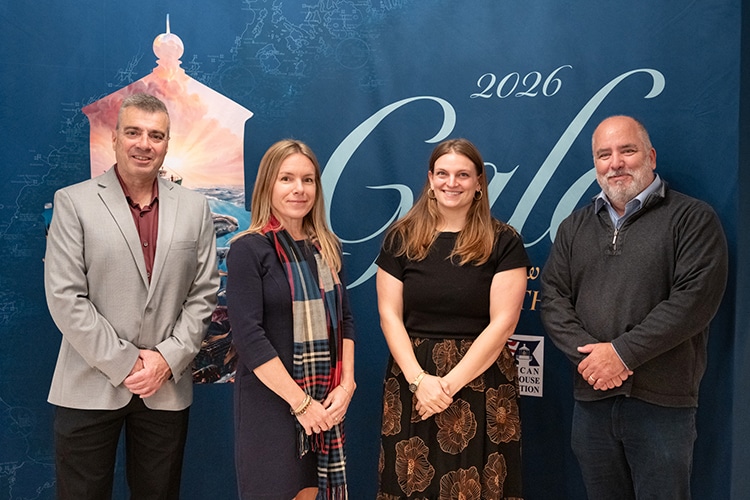
The ALF Gala’s Keynote Presentation — Lighthouses, Technology & Marine Conservation, connected the mission of lighthouse preservation with efforts to protect the endangered North Atlantic right whale through the use of the AIS-based StationKeeper technology.
(L to R) Bob Trapani, Jr., Executive Director, American Lighthouse Foundation, Stacey Hedman, Senior Director of Communications, Global Programs, International Fund for Animal Welfare, Kathleen Collins, Senior Marine Campaigns Manager, International Fund for Animal Welfare, and Moses Calouro, CEO, MotionInfo, a marine technology company based in Orleans, Massachusetts.
(Photo by Dominic Trapani)
The International Fund for Animal Welfare (IFAW) have been a key fiscal sponsor and conservation partner. Representing IFAW at the Gala were Kathleen Collins, Senior Marine Campaigns Manager and Stacey Hedman, Senior Director of Communications, Global Programs at IFAW. They shared fabulous presentations about the plight of the North Atlantic right whale and what is being done to protect them. Likewise, they focused on examples of their conservation work form around the world and spoke to why collaborations like the one with the American Lighthouse Foundation and StationKeeper are vital for whale conservation success.
This past week I meet Moses and Portia Calouro for dinner in Halifax, Nova Scotia while attending the North Atlantic Right Whale Consortium. A burning question I had was how much additionality had come to broadcasting right whale slow zones to ships from the use of lighthouses. Moses believes that the lighthouses alone have doubled the range that the AIS signals can reach ships to alert them to slow down. Research has shown that slowing ships down from 20 or 15 knots to less than 10 knots can reduce the risk to whale ship strikes.
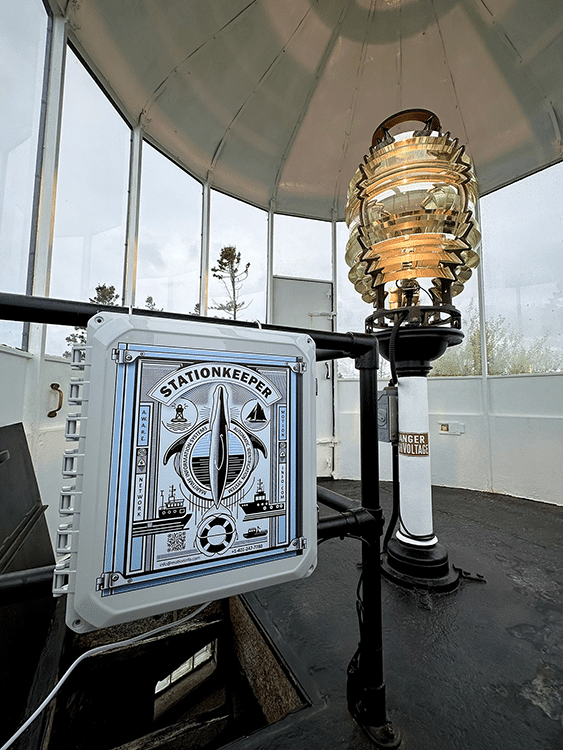
MotionInfo’s AIS-based StationKeeper technology inside the lantern of Owls Head Lighthouse.
(Photo by Bob Trapani, Jr.)
The impact of climate change on right whales and the oceans in general cannot be understated. Thirteen years ago, right whales started moving around more and into the Gulf of Saint Lawerence in search of prey because of the disruption of warm gulf stream water into the Gulf of Maine. Fortunately, while Moses and Portia where in Halifax they had the opportunity to meet with Canadian counterparts and make some plans for extending StationKeeper into Canada and onto Canadian lighthouses.
There are many scientists and conservationists who have dedicated their careers and huge efforts to seeing the population of Right Whales return to the thousands one day. Thanks to terrific partnerships, the vision of Phin Sprague Jr., the support of the International Fund for Animal Welfare and American Lighthouse Foundation, and the work of MotionInfo, this StationKeeper project can play an important role in bringing that conservation dream to fruition. Years ago, the lighthouses were lit with right whale oil but now are being used to save the whales. It many ways it feels like a full circle moment.
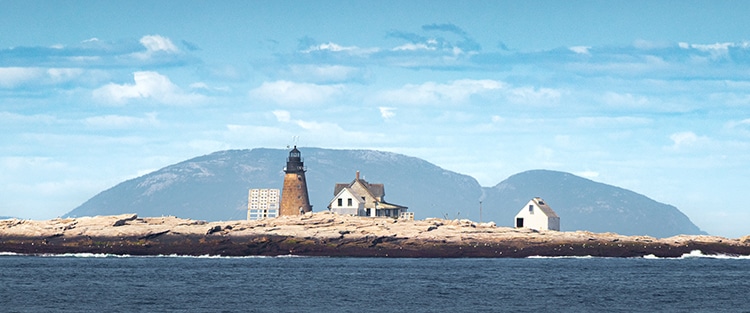
Mount Desert Rock, owned by the College of Atlantic, is located twenty-five miles offshore from Bar Harbor, Maine, and is a StationKeeper Light.
(Photo by Dominic Trapani)
 Zack Klyver is 35-year Bar Harbor whale watch naturalist and the co-chair of the North Atlantic Whale Watch Naturalist Association. He works as an independent ocean conservation consultant and as the marine mammal science and policy advisor for Blue Green Future whose pioneering work includes the economic valuation of the ecosystem services of whales and the development of “ReGDP” as a measure of a countries wealth that incorporates living nature.
Leave a Reply